
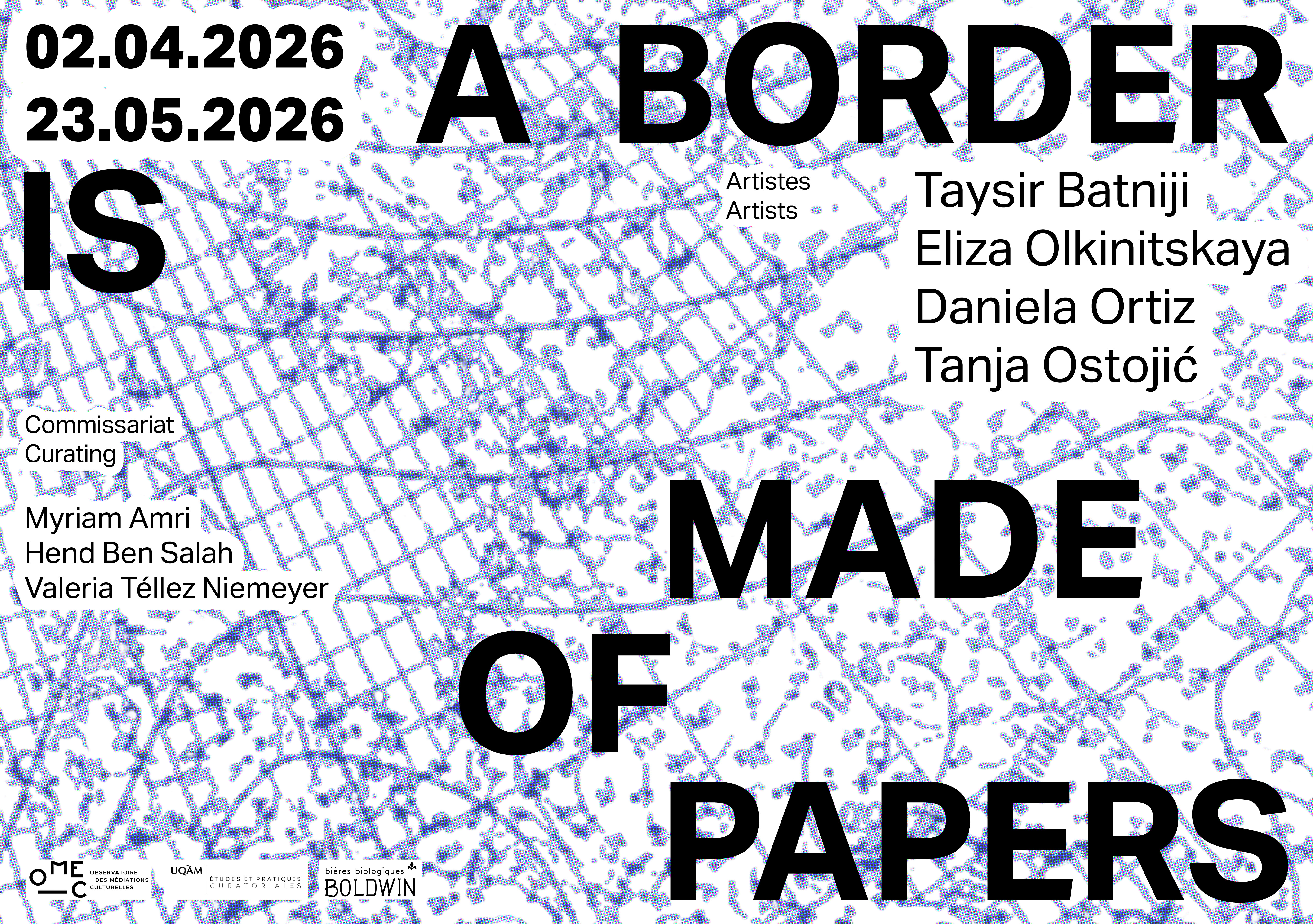
02.04.2026 — 23.05.2026
SBC Galerie d’art contemporain
372, rue Ste-Catherine Ouest, espace 507, Tiohtià:ke/Montréal
The arrival desk, the line at the checkpoint, the routine inspections, the secondary zone interrogations, the life-altering decisions, and, of course, the paperwork: passports, visas, residence permits, proofs, and supporting documents. Crossing a border brings one’s individual condition into the fold of systems that determine who and how one can cross a border. How do bureaucracies (re)produce borders today?
A Border is Made of Papers illuminates the material regimes that underpin borders. Documents, institutions, places, and language itself are processes that define mobility across geographies. This exhibition looks at borders from within, prying open the bureaucratic systems that shape people’s movements. It looks from within, meaning it begins with the documents one has to produce and accumulate to prove ‘worthy’ of crossing a border. A Border is Made of Papers looks from these documents to the language they force on those crossing, the choices they impose on one’s life, the sites they have to be shown in, and the border systems they help enforce.
In times where brutal violence structures borders – colonial expansion, detention systems, externalisation, criminalization – this exhibition draws attention to bordering as exerting its hold through mundane processes often unknown to people with legal status. It thus refuses the binary that distinguishes violence from bureaucracy or legal from illegal migration, to instead locate the bureaucratic webs, arbitrary logics, material objects, and even the weight of documents that borders force on many of us.
This exhibition looks from Montreal outwards, asking about borders from a city that imagines itself to be cosmopolitan and from a country whose reputation as a safe haven is increasingly challenged. It reveals how the facade of multiculturalism conceals vast bureaucratic systems that migrants encounter daily while remaining invisible to the rest of society.
A Border is Made of Papers presents the work of four artists who are themselves caught in the web of borders. The exhibition illuminates how artists have to navigate the logics of borders and how they subvert them by refusing to separate their experiences from the need to create art to expose these systems. Their works on display bear witness to migration systems that span different time periods but whose underlying principles continue today.
The physical crossing of the border is explored by the Gaza-born artist Taysir Batniji, who centers on the Rafah border crossing in Transit (2004), a silent slideshow that documents the experience of Palestinians attempting to cross. The sequence of photographic images, punctuated by black frames in sync with the projector’s rhythm, conveys the uncertainty and endless waiting that define their daily lives. Taken secretly by the artist, these photographs reveal the constraints faced by Palestinians, whose movements continue to be conditioned by the impossibility of returning home. The Rafah crossing, Gaza’s only border crossing since the Second Intifada, is currently closed despite the “ceasefire” declared in January 2025.
The liminal state imposed by immigration regimes is also highlighted in the video FDTD (2012) by Peruvian artist Daniela Ortiz. Focusing on the waves of forced deportations carried out by ICE in the United States since 2003, the artist subjects her own body to the violence of borders by injecting herself with the sedatives administered to those deported. During the performance, she reads aloud the free trade agreement signed between Peru and the United States, thereby exposing the hypocrisy of a system that guarantees the free movement of goods but denies that of human beings.
Arbitrary restrictions and bans on movement are central to the work of artist Eliza Olkinitskaya. In Droit de passage (2026), a performance-installation premiering at this exhibition, the artist directly engages the audience by creating a physical barrier to access the exhibition space. This barrier, which echoes the institutionalized rituals of borders, is governed by random and capricious rules imposed by an imaginary agent whom she herself embodies.
The migratory journeys of the exhibiting artists have shaped their lives as much as their artistic practices. Batniji became a citizen of France, Ortiz of Spain, and Olkinitskaya of Canada. Tanja Ostojić transformed this process into a multimedia work in Looking for a Husband with EU Passport (2000–2005). In this work, the Serbian-born artist recounts the years she spent trying to obtain a residence permit in the European Union. She candidly displays her online marketing strategy, her legal marriage to a German citizen, and her eventual divorce. Straddling the line between reality and performance, this installation highlights the bureaucratic logic rooted in the structural inequalities that underpin Europe’s increasingly restrictive immigration systems.
As for the objects that do borders, they appear in every work, fleetingly or front and center, including originals, copies, reproductions, and even fake documents that highlight the weight of lives governed by such seemingly innocuous pieces of paper. An exit permit is waved from the fingertips of a Palestinian at the Rafah border crossing in Transit (2004); a large-format copy of the artist’s visa is displayed between two wedding photos in Looking for a Husband with EU Passport (2000–2005). In Paper, Please (2019), Eliza Olkinitskaya handcrafts seven fake passports to confront us with these objects, whose material fragility only reinforces their symbolic significance. Meanwhile, in The ABC of Racist Europe (2017), Daniela Ortiz links object, language, and aesthetics by appropriating the world of children’s books to give it a new form: an alphabet book of the words that govern border systems.
All of these works subvert what is often invisible in border regimes: limbos, languages, their absurdity, and arbitrariness. They ask us to feel borders through their material hold, and as they continue to control bodies through paperwork. A Border is Made of Papers invites the public to grasp how bureaucracies and their documents turn mobility into violence by establishing borders and determining who gets to belong.
